博文

目前显示的是标签为“Sinonine”的博文

Mineral processing unit operation and examples
图片
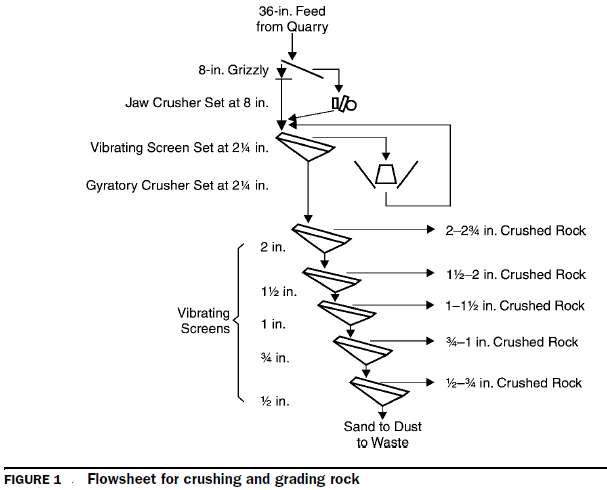
UNIT OPERATIONS In mineralprocessing plant , Numerous steps, called unit operations, are involved in achieving the goal of extracting minerals and metals from ores in their purest possible form. These steps include Size reduction . The process of crushing and grinding ores is known as comminution. The purpose of the comminution process is threefold: (1) to liberate valuable minerals from the ore matrix, (2) to increase surface area for high reactivity, and (3) to facilitate the transport of ore particles between unit operations. Size separation. Crushed and ground products generally require classification by particle size. Sizing can be accomplished by using classifiers, screens, or water elutriators. Screens are used for coarse particulate sizing; cyclones are used with fine particulates. Concentration . Physicochemical properties of minerals and other solids are used in concentration operations. Froth flotation, gravity concentration, and magnetic and electrostatic co...

GOALS AND BASICS OF MINERAL PROCESSING

图片
In the traditional sense, mineral processing is regarded as the processing of ores or other materials to  yield concentrated products. Most of the processes involve physical concentration procedures during  which the chemical nature of the mineral(s) in question does not change. In hydrometallurgical processing, however, chemical reactions invariably occur; these systems are operated at ambient or elevated temperatures depending on the kinetics of the processes. The lead zinc ore processing in the production of metals is to yield metals in their purest form. Mineral processing plays an integral part in achieving this objective. Figure 1 shows a generalized flow diagram for metals extraction from mining (step 1) through chemical processing. Steps 2 and 3 involve physical processing and steps 5 and 7 involve low-temperature chemical processing (hydrometallurgy). All four steps are considered part of mineral processing. High-temperature smelting and refining (pyrometall...

Storage Buffering in mineral processing plant

图片
In mineral processing plant,Buffer storage is some time called “the key to processing”, meaning that without a proper storage throughout a continuous rock or mineral process, production uptime will be gone. Storage in operation The main purpose of storage is to smooth out: • Different production rates (cont.cyclic) • Shift variations • Interruptions for repair • Size variations • Flow variations • Variations in mineral value (metal content etc.) Storage of rock (1) A matter of material flow (retention time),see below the crushing system of lead zinc ore processing : Storage of ore and minerals (2) A matter of material flow (retention time) and blending sinonine can also provide  sand washing plant  epc. Sinoninetechnology team

Separation by Leaching

图片
When mechanical methods of separation cannot secure optimal metal value of an ore,leaching is an alternative, either as a complement or as an overall process. Most of the leaching process is feed preparation by crushing, grinding and in some cases pre-concentration and roasting. The separation is normally done by creating retention time for the chemicals to penetrate the feed. The waste and heap leaching operations are typically low in investment but high in cost of chemicals. Recovery is normally low (below 60%). The agitation methods (con current or counter current) are high in investment but are paid back in higher recovery. Leaching by size In leaching there is always an optimum in the relation feed size versus recovery. This balance between cost for size reduction and value recovery is important to establish for high value ores, see below. Leachants Leaching of Metals Below find the flow sheets for classical leaching circuits, heap leaching for coarse...

Mineral Processing Flowsheets

图片
In mineral processing plant , A general flowsheet involving almost all the unit operations pertinent to mineral processing is shown in Figure 1. The others refer specifically to beach sands, lead   zinc mining plant , molybdenum, and the rare earths . Processing of silica sands provides a good example of the response of minerals to magnetic and electrostatic fields. A generalized flowsheet for separating the mineral constituents of beach sands is shown in Figure 2 . It will be seen that the separation is essentially based on the differences in the magnetic properties and in the electrical conductivity of the various minerals present in the beach sands. The behaviour of some typical beach sand minerals, as for instance magnetite, ilmenite, garnet, monazite, rutile, zircon, and quartz , in respect of their responses towards magnetic and electrostatic separators. A reference is also drawn to Figure 3 which exclusively shows flotation playing the centrally important role in lead...

Thickeners

图片
In beneficiation plant , a conventional thickener consists of a circular tank with a central feedwell and peripheral weir overflow. Bottom slope will have a ratio of 1:12 up to 3:12 depending primarily on tank diameter and particle size distribution. For large-diameter units or for feeds containing a high percentage of coarser, fast-settling solids, a double slope is used. The inner third (approximately) of the diameter might have a 2:12 or 3:12 slope and the outer portion a 1:12 slope. (The use of rectangular and square tanks in coal processing is gradually decreasing.) Most thickeners will run at 0% – 20% of rated torque and as such will have a service life of 20 years or more. The great amount of extra torque is called into play in an upset condition (such as excessively coarse solids, underflow pump shutdown, excessive tonnages, or foreign object) to prevent a shutdown and the need to dig out the unit. The overflow is usually recycled back to processing for reuse. If it is to ...

Which devices are used for size reduction of mineral?

In practice, size reduction of mineral particle assemblies is accomplished stepwise in commercial devices. The complicating features in the breakage of large assemblies of particles are the different particle sizes and strengths and the sometimes random way in which stress is applied in the various steps. In mining operations, blasting with explosives is usually the first step in the comminution sequence. During blasting, high-velocity gas pressure pulses created by the explosives load blocks of ores to provide initial fragmentation. The next step in mineral processing plant is typically crushing, which is accomplished by slow compression of large particles (greater than 1 cm) against rigid surfaces. The mechanism of breakage in the crushing step is contrasted with subsequent size reduction by tumbling or stirred mills in which breakage of smaller particles (less than 1 cm) is accomplished by a combination of impact, chipping, and abrasion events caused by energy transferred from gri...

Thickener Control

图片
In a beneficiation plant , the control of thickener operation is directed to obtaining a clear overflow as rapidly as possible. The sedimentation rate is usually accelerated by additions of flocculants. Flocculants are added in the feed pipe (or feed launder) and maximum dispersion attempted by appropriate design of its entry to the thickener tank. The object is to entirely cover all the surface of mineral particles. The choice of flocculent and its concentration vary. It depends on the minerals present in the slurry, their composition and their surface characteristics. It is necessary not to have too much turbulence at the entry point of the tank.. For this purpose, the overflow level is kept sufficiently high above the feed level to ensure acceptable solid concentration in the overflow. Fig. 1 is a schematic diagram of a thickener showing the different parameters. From a process control point of view the design parameters and major variables are: 1. height of the overflow cl...

Crushing plant control

图片
In mineral processing plant , The control of any crushing operations starts with the control of the feed system. We has summarized the disturbances in a crusher as: 1. ore properties (size and hardness), 2. ore feed rate, 3. crusher settings (close and open settings) — alterations due to wear and tear, 4. surge in feed load and plant power draw. The control loops of a gold crushing plant are shown in Fig. 1. Fig1. Control of gold crushing plant Two regulatory control loops and a supervisory control loop are shown. The function of one regulatory loop (shown within dotted lines) is to control the feed tonnage on the feeder conveyor and the other to regulate the crusher power which in turn regulates the feed. The supervisory loop is a cascade loop which deals with any imbalance between the two regulatory loops through level changes in the feed hopper. The basic instrumentation involved would include a transducer to monitor the closed side setting (and or open si...

Mineral processing process control modes

图片
In mineral processing plan t, the process control is important and necessary. Processcontrol systems can be divided into two major groups: 1. Continuous control that involve monitoring and controlling of events continuously, 2 Digital controls that involve the use of computers and microprocessors. Controlling, say the level of a flotation tank which is being filled continuously and from which the pulp is withdrawn continuously, can be done crudely by observing the rise (or fall) of level and restoring it manually by manipulating valves and increasing or decreasing the input flow rate to the tank. Such an on-off method would result in an unsteady profile of level (Fig. 1). This situation is unacceptable in most mineral processing circuits. To solve the problem instruments have been devised and strategies developed to minimize the fluctuations in level. Automatic controllers have therefore being devised which serve to control flow rates, density of slurries, tank and bin levels...

Flotation reagents-fronther and modifiers

In flotation beneficiation plant , main euipments are important such as ball mill, flotation machine, crushing machine etc. And the flotation reagents are also important for flotation process, the reagents used in flotation are usually divided into three classes: Collectors : organic chemicals which make the surface hydrophobic and hence the mineral is capable of being collected in the process. Frothers : organic chemicals which reduce the surface tension of the water to stabilize the bubbles into a froth layer at the top of the flotation cell to make concentrate removal easier. Modifiers : organic or inorganic chemicals used to modify the slurry conditions to enhance the difference in surface chemistry between the valuable and gangue minerals. Let’s introduce frothers and modifiers in this article Frothers Frothers are surfactants, usually organic heteropolar compounds such as alcohols or polyglycol ethers. Due to the heteropolar nature, the frother adsorbs at the air/w...