博文

目前显示的是标签为“flotation”的博文

Mineral Processing Flowsheets

图片
In mineral processing plant , A general flowsheet involving almost all the unit operations pertinent to mineral processing is shown in Figure 1. The others refer specifically to beach sands, lead   zinc mining plant , molybdenum, and the rare earths . Processing of silica sands provides a good example of the response of minerals to magnetic and electrostatic fields. A generalized flowsheet for separating the mineral constituents of beach sands is shown in Figure 2 . It will be seen that the separation is essentially based on the differences in the magnetic properties and in the electrical conductivity of the various minerals present in the beach sands. The behaviour of some typical beach sand minerals, as for instance magnetite, ilmenite, garnet, monazite, rutile, zircon, and quartz , in respect of their responses towards magnetic and electrostatic separators. A reference is also drawn to Figure 3 which exclusively shows flotation playing the centrally important role in lead...
Flotation reagent-collectors

图片
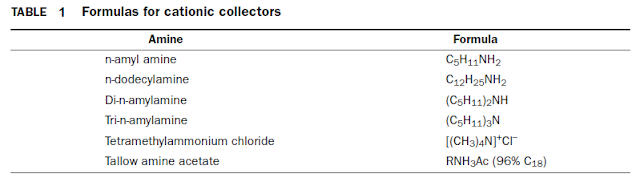
In mineral processing plant ,a number of organic and inorganic reagents are used in flotation and auxiliary processes to achieve separation, including collectors, frothers, extenders, activators, depressants, deactivators, flocculants, and dispersants. Collectors, frothers, and extenders are surfactants added to impart hydrophobicity to the minerals and to make selective adsorption of the collector possible or to eliminate interference to flotation by various dissolved or colloidal species. We discuss collectors this time. Collectors The primary role of the collector is to adsorb selectively, which imparts hydrophobicity to particles of the mineral to be floated. If it is to have the dual ability to adsorb and to impart hydrophobicity, the collector molecule must contain at least two functional parts, a nonpolar group of sufficient hydrophobicity and a polar or ionic group that will be electrostatically or chemically reactive toward species on the mineral surface. The nonpolar pa...

Mineral processing process control modes

图片
In mineral processing plan t, the process control is important and necessary. Processcontrol systems can be divided into two major groups: 1. Continuous control that involve monitoring and controlling of events continuously, 2 Digital controls that involve the use of computers and microprocessors. Controlling, say the level of a flotation tank which is being filled continuously and from which the pulp is withdrawn continuously, can be done crudely by observing the rise (or fall) of level and restoring it manually by manipulating valves and increasing or decreasing the input flow rate to the tank. Such an on-off method would result in an unsteady profile of level (Fig. 1). This situation is unacceptable in most mineral processing circuits. To solve the problem instruments have been devised and strategies developed to minimize the fluctuations in level. Automatic controllers have therefore being devised which serve to control flow rates, density of slurries, tank and bin levels...

Flotation reagents-fronther and modifiers

In flotation beneficiation plant , main euipments are important such as ball mill, flotation machine, crushing machine etc. And the flotation reagents are also important for flotation process, the reagents used in flotation are usually divided into three classes: Collectors : organic chemicals which make the surface hydrophobic and hence the mineral is capable of being collected in the process. Frothers : organic chemicals which reduce the surface tension of the water to stabilize the bubbles into a froth layer at the top of the flotation cell to make concentrate removal easier. Modifiers : organic or inorganic chemicals used to modify the slurry conditions to enhance the difference in surface chemistry between the valuable and gangue minerals. Let’s introduce frothers and modifiers in this article Frothers Frothers are surfactants, usually organic heteropolar compounds such as alcohols or polyglycol ethers. Due to the heteropolar nature, the frother adsorbs at the air/w...

Mineral froth flotation

图片
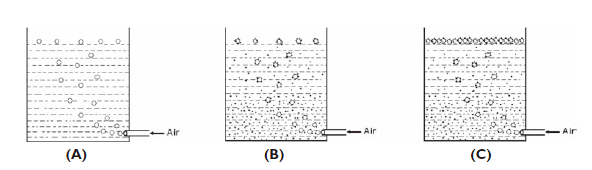
Sinonine deeply know that in a beaker of water, if air is introduced from the bottom, air bubbles are produced  and rise to the surface of the water as the density of an air bubble is much less than that of water (Figure.1 A). Similarly air bubbles also rise if air is introduced in a pulp containing mineral particles. If a mineral particle of high density adheres to the air bubble, the air bubble along with the mineral particle rises to the surface because the apparent density of the air bubble and the adhered mineral particle is less than that of water. If many mineral particles are adhered to the air bubble, still the air bubble rises to the surface as the apparent density of the air bubble and adhered mineral particles is less than that of water due to the relatively large volume of the air bubble Figure 1 B). This concept is the basis for froth flotation operation. To use this concept or phenomenon, the following are required: 1 Met...

Flowsheet of Mineral beneficiation plant

图片
The Mineral Beneficiation plant for separating metalliferous mineral from gangue is called a concentrator or a mill and the process is called concentration or milling. Minerals are beneficiated in several ways. The operations employed for the beneficiation of minerals depends on: Liberation size Physical properties such as; Specific gravity, Surface property, Magnetic susceptibility, Electrical conductivity etc. Required grade of the ore Operating characteristics of the equipment used Financial feasibility Detailed laboratory investigations are to be carried out in order to assess the various properties of the minerals present in the ore before planning for its beneficiation. For the beneficiation of Iron ores, processes such as sizing, washing, gravity concentration like heavy medium separation, jigging, spiraling and magnetic separation are in use, after comminution to appropriate sizes. Jigging and heavy medium separation operations are used for...