博文

目前显示的是标签为“beneficiation”的博文

Mineral beneficiation-ore liberation

图片
Sinonine deeply know that liberation is the first and the most important step in Mineral Beneficiation . The second step, separation, is impracticable if the first step, liberation, is not accomplished successfully. Liberation can be defined as the freeing or detachment of dissimilar mineral grains. The operation employed to liberate the dissimilar mineral grains is Size reduction or Comminution. If the particles of ore consist of a single mineral, they are termed as Free particles. If the particles of ore consist of two or more minerals, they are termed as locked particles. If the locked particles contain valuable minerals at considerable quantity, they are termed as middling particles. Grain size : It is the size of a mineral as it occurs in the ore. Particle size : It is the size of any particle whether free or locked particle. Grain and Grain size pertain to uncrushed ore and Particle and Particle size pertain to crushed or ground ore. Liberation size : It is the size ...

Centrifugal separators

图片
Sinonine think that centrifugal separator is an important gravity equipment in beneficiation plant. Heavy medium cyclone is a centrifugal separator similar to the conventional hydrocyclone in principle of operation. It provides a high centrifugal force and a low viscosity of the medium. Much finer separations are achieved in Heavy medium cyclone than in gravity separators. The ore or coal is suspended in a very fine medium of ferrosilicon or magnetite, and is fed tangentially to the Heavy medium cyclone under pressure. The sink product leaves the cyclone at the apex and the float product is discharged through the vortex finder. These cyclones are commonly installed with axes at 10–15° to the horizontal, thereby enabling the unit to be fed at comparatively low inlet pressure, preferably from a steady head tank. Heavy medium cyclones are widely used for beneficiation of coal in the size range of 13–0.5 mm in coal washeries. By giving a special shape to the cone, and to the cylindr...

Mineral froth flotation

图片
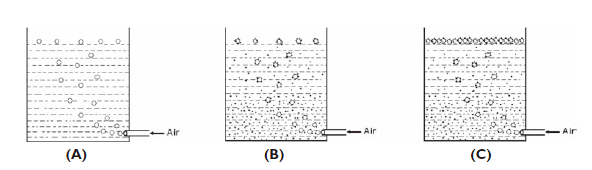
Sinonine deeply know that in a beaker of water, if air is introduced from the bottom, air bubbles are produced  and rise to the surface of the water as the density of an air bubble is much less than that of water (Figure.1 A). Similarly air bubbles also rise if air is introduced in a pulp containing mineral particles. If a mineral particle of high density adheres to the air bubble, the air bubble along with the mineral particle rises to the surface because the apparent density of the air bubble and the adhered mineral particle is less than that of water. If many mineral particles are adhered to the air bubble, still the air bubble rises to the surface as the apparent density of the air bubble and adhered mineral particles is less than that of water due to the relatively large volume of the air bubble Figure 1 B). This concept is the basis for froth flotation operation. To use this concept or phenomenon, the following are required: 1 Met...

Mineral Beneficiation Operation

图片
Sinoninetech deeply know that beneficiation operations are physical or mechanical unit operations where valuable mineral particles are separated from the mixture of liberated valuable mineral particles and gangue mineral particles. Every beneficiation operation is based on one or more physical properties in which valuable and gangue minerals differ in that property. Major beneficiation operations and the basis of separation are given in Table 1 Table 1 Beneficiation operations and basis of separation The following important terminology is used in Mineral Industries. 1 ) Concentrate: The valuable mineral product obtained from the beneficiation operation. 2 ) Tailing: The waste or gangue mineral product obtained from the beneficiation operation. Practically all the valuable mineral particles cannot be separated due to: ---- Incomplete liberation. ---- Inefficiency of beneficiation operation (. Hence both the concentrate and the tailing contain locked particles of...