博文

目前显示的是标签为“thickener”的博文

Thickeners

图片
In beneficiation plant , a conventional thickener consists of a circular tank with a central feedwell and peripheral weir overflow. Bottom slope will have a ratio of 1:12 up to 3:12 depending primarily on tank diameter and particle size distribution. For large-diameter units or for feeds containing a high percentage of coarser, fast-settling solids, a double slope is used. The inner third (approximately) of the diameter might have a 2:12 or 3:12 slope and the outer portion a 1:12 slope. (The use of rectangular and square tanks in coal processing is gradually decreasing.) Most thickeners will run at 0% – 20% of rated torque and as such will have a service life of 20 years or more. The great amount of extra torque is called into play in an upset condition (such as excessively coarse solids, underflow pump shutdown, excessive tonnages, or foreign object) to prevent a shutdown and the need to dig out the unit. The overflow is usually recycled back to processing for reuse. If it is to ...

Thickener Control

图片
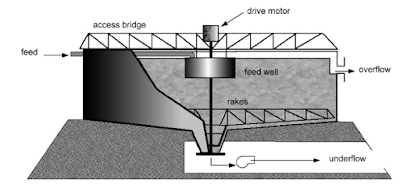
In a beneficiation plant , the control of thickener operation is directed to obtaining a clear overflow as rapidly as possible. The sedimentation rate is usually accelerated by additions of flocculants. Flocculants are added in the feed pipe (or feed launder) and maximum dispersion attempted by appropriate design of its entry to the thickener tank. The object is to entirely cover all the surface of mineral particles. The choice of flocculent and its concentration vary. It depends on the minerals present in the slurry, their composition and their surface characteristics. It is necessary not to have too much turbulence at the entry point of the tank.. For this purpose, the overflow level is kept sufficiently high above the feed level to ensure acceptable solid concentration in the overflow. Fig. 1 is a schematic diagram of a thickener showing the different parameters. From a process control point of view the design parameters and major variables are: 1. height of the overflow cl...

Thickener and its circuit

图片
In   beneficiation plant , thickeners are essentially clarifiers producing a clearer over flow. The design considerations are based on the settling rates of the slowest settling particles and conditions for minimum disturbance of the medium (water) through which the solid particles are allowed to settle. To achieve these objectives cylindrical tanks with conical or flat bottoms are used and the velocity of the feed slurry entering the settling tank is minimised to reduce turbulence in the settling tank. A schematic diagram of a typical thickener is shown in Fig.1. The feed in the form of slurry is generally guided by a launder, which is laid at a slope just sufficient for the slurry to flow without depositing any solids. The feed launder terminates in a feed well located at the centre of the tank. The feed well is designed to break the fall of the slurry and dissipate the energy. Fig1. Sketch of bridge type thickener The feed well is concentric with the rake driving shaft. T...