博文

目前显示的是标签为“mineral processing plant”的博文

Mineral processing unit operation and examples
图片
UNIT OPERATIONS In mineralprocessing plant , Numerous steps, called unit operations, are involved in achieving the goal of extracting minerals and metals from ores in their purest possible form. These steps include Size reduction . The process of crushing and grinding ores is known as comminution. The purpose of the comminution process is threefold: (1) to liberate valuable minerals from the ore matrix, (2) to increase surface area for high reactivity, and (3) to facilitate the transport of ore particles between unit operations. Size separation. Crushed and ground products generally require classification by particle size. Sizing can be accomplished by using classifiers, screens, or water elutriators. Screens are used for coarse particulate sizing; cyclones are used with fine particulates. Concentration . Physicochemical properties of minerals and other solids are used in concentration operations. Froth flotation, gravity concentration, and magnetic and electrostatic co...

Storage Buffering in mineral processing plant

图片
In mineral processing plant,Buffer storage is some time called “the key to processing”, meaning that without a proper storage throughout a continuous rock or mineral process, production uptime will be gone. Storage in operation The main purpose of storage is to smooth out: • Different production rates (cont.cyclic) • Shift variations • Interruptions for repair • Size variations • Flow variations • Variations in mineral value (metal content etc.) Storage of rock (1) A matter of material flow (retention time),see below the crushing system of lead zinc ore processing : Storage of ore and minerals (2) A matter of material flow (retention time) and blending sinonine can also provide  sand washing plant  epc. Sinoninetechnology team

Selection of Crushers

图片
In mineralprocessing plant , Knowing the number of crushing stages we can now start to select the correct crusher for each reduction stage. Depending on operating conditions, feed size, capacity, hardness etc, there are always some options. For primary crushers, see below. Stationary crushers Mobile Crushers Primary Crusher For soft feed (below Mohs5) a horizontal Impactor (HSI) is normally the first option if capacity is not too high. For harder feed there is a choice between a gyratory or a jaw crusher , see below. Rule 1: Always use a jaw crusher if you can, being the most cost effective alternative. Rule 2: For low capacity use jaw crusher and hydraulic hammer for oversize Rule 3: For high capacities use jaw crusher with big intake opening Rule 4: For very high capacities use gyratory crusher Secondary Crusher In a rock crushing circuit, the second stage normally starts to be of importance for control of size and shape. Because of this the jaw cr...

Mineral Processing Flowsheets

图片
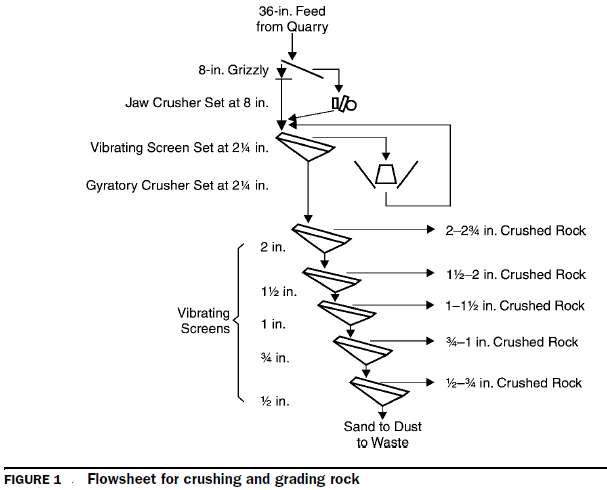
In mineral processing plant , A general flowsheet involving almost all the unit operations pertinent to mineral processing is shown in Figure 1. The others refer specifically to beach sands, lead   zinc mining plant , molybdenum, and the rare earths . Processing of silica sands provides a good example of the response of minerals to magnetic and electrostatic fields. A generalized flowsheet for separating the mineral constituents of beach sands is shown in Figure 2 . It will be seen that the separation is essentially based on the differences in the magnetic properties and in the electrical conductivity of the various minerals present in the beach sands. The behaviour of some typical beach sand minerals, as for instance magnetite, ilmenite, garnet, monazite, rutile, zircon, and quartz , in respect of their responses towards magnetic and electrostatic separators. A reference is also drawn to Figure 3 which exclusively shows flotation playing the centrally important role in lead...

Flotation reagent-collectors

图片
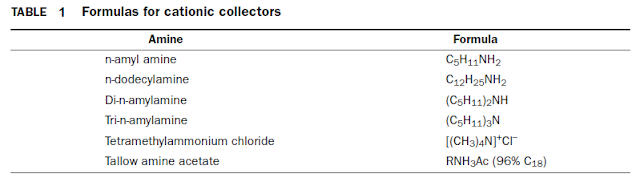
In mineral processing plant ,a number of organic and inorganic reagents are used in flotation and auxiliary processes to achieve separation, including collectors, frothers, extenders, activators, depressants, deactivators, flocculants, and dispersants. Collectors, frothers, and extenders are surfactants added to impart hydrophobicity to the minerals and to make selective adsorption of the collector possible or to eliminate interference to flotation by various dissolved or colloidal species. We discuss collectors this time. Collectors The primary role of the collector is to adsorb selectively, which imparts hydrophobicity to particles of the mineral to be floated. If it is to have the dual ability to adsorb and to impart hydrophobicity, the collector molecule must contain at least two functional parts, a nonpolar group of sufficient hydrophobicity and a polar or ionic group that will be electrostatically or chemically reactive toward species on the mineral surface. The nonpolar pa...

Which devices are used for size reduction of mineral?

In practice, size reduction of mineral particle assemblies is accomplished stepwise in commercial devices. The complicating features in the breakage of large assemblies of particles are the different particle sizes and strengths and the sometimes random way in which stress is applied in the various steps. In mining operations, blasting with explosives is usually the first step in the comminution sequence. During blasting, high-velocity gas pressure pulses created by the explosives load blocks of ores to provide initial fragmentation. The next step in mineral processing plant is typically crushing, which is accomplished by slow compression of large particles (greater than 1 cm) against rigid surfaces. The mechanism of breakage in the crushing step is contrasted with subsequent size reduction by tumbling or stirred mills in which breakage of smaller particles (less than 1 cm) is accomplished by a combination of impact, chipping, and abrasion events caused by energy transferred from gri...

Crushing plant control

图片
In mineral processing plant , The control of any crushing operations starts with the control of the feed system. We has summarized the disturbances in a crusher as: 1. ore properties (size and hardness), 2. ore feed rate, 3. crusher settings (close and open settings) — alterations due to wear and tear, 4. surge in feed load and plant power draw. The control loops of a gold crushing plant are shown in Fig. 1. Fig1. Control of gold crushing plant Two regulatory control loops and a supervisory control loop are shown. The function of one regulatory loop (shown within dotted lines) is to control the feed tonnage on the feeder conveyor and the other to regulate the crusher power which in turn regulates the feed. The supervisory loop is a cascade loop which deals with any imbalance between the two regulatory loops through level changes in the feed hopper. The basic instrumentation involved would include a transducer to monitor the closed side setting (and or open si...

Mineral processing process control modes

图片
In mineral processing plan t, the process control is important and necessary. Processcontrol systems can be divided into two major groups: 1. Continuous control that involve monitoring and controlling of events continuously, 2 Digital controls that involve the use of computers and microprocessors. Controlling, say the level of a flotation tank which is being filled continuously and from which the pulp is withdrawn continuously, can be done crudely by observing the rise (or fall) of level and restoring it manually by manipulating valves and increasing or decreasing the input flow rate to the tank. Such an on-off method would result in an unsteady profile of level (Fig. 1). This situation is unacceptable in most mineral processing circuits. To solve the problem instruments have been devised and strategies developed to minimize the fluctuations in level. Automatic controllers have therefore being devised which serve to control flow rates, density of slurries, tank and bin levels...

Thickener and its circuit

图片
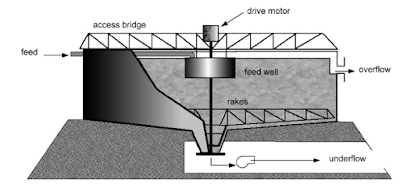
In   beneficiation plant , thickeners are essentially clarifiers producing a clearer over flow. The design considerations are based on the settling rates of the slowest settling particles and conditions for minimum disturbance of the medium (water) through which the solid particles are allowed to settle. To achieve these objectives cylindrical tanks with conical or flat bottoms are used and the velocity of the feed slurry entering the settling tank is minimised to reduce turbulence in the settling tank. A schematic diagram of a typical thickener is shown in Fig.1. The feed in the form of slurry is generally guided by a launder, which is laid at a slope just sufficient for the slurry to flow without depositing any solids. The feed launder terminates in a feed well located at the centre of the tank. The feed well is designed to break the fall of the slurry and dissipate the energy. Fig1. Sketch of bridge type thickener The feed well is concentric with the rake driving shaft. T...